I led the design of two new PactFi capabilities, Signature Blocks and Custodian Reporting, that helped deal teams replace manual coordination with configurable workflows built around transaction data already available in the platform.
Please note that certain details and information have been omitted or altered to protect the privacy and confidentiality of the organizations involved.*


PactFi helps private-credit firms and their counterparties coordinate complex transactions involving multiple organizations, legal entities, signatories, and sensitive information under tight timelines.
Without a centralized workflow, deal teams relied on emails, Excel spreadsheets, Word and PDF files, and past transactions. This made it harder to collect accurate information, identify gaps, and prepare consistent materials.
Before PactFi

With PactFi

MY ROLE
I joined a five-person design team, initially working on platform enhancements to learn PactFi’s interconnected workflows and design system. I then became the primary designer for Signature Blocks and Internal and External Custodian Reporting.
For both projects, I partnered closely with product managers to translate client requirements into workable product experiences. I mapped workflows, explored interaction patterns, identified edge cases, created prototypes, incorporated feedback from PMs and other designers, and supported engineering and QA through implementation.
Because the platform handled sensitive client information, PMs led direct client conversations and brought requirements and feedback back to the design team. I worked with them to clarify how each workflow should behave, surface unanswered questions, and translate industry-specific requirements into understandable interactions. PMs then used our prototypes to validate the experiences with existing clients before development.
01
SIGNATURE BLOCKS
A signature block defines who signs a legal document, which entity they represent, and their authority to sign. The legal party might be a fund represented by a general partner or investment manager, with an authorized individual signing on its behalf. More complex structures can include several of these layers.
Before PactFi introduced Signature Blocks, operations teams gathered this information from emails, documents, attachments, and previous deals. Across transactions with many entities, they had to locate and verify different roles, manager structures, and signatories, then manually assemble a packet for counsel. This repetitive process was difficult to manage, and missing or outdated information could delay document preparation.
THE DESIGN CHALLENGE
How might we help operations teams configure signing relationships across many legal entities and generate document-ready packets while maintaining the flexibility required for different organizational structures?
What appeared to be a download feature was actually a configuration system that needed to support:
DESIGN DECISION 01
A form, wizard, or separate page could guide users through one entity at a time, but would make it harder to compare entities, identify missing information, or update multiple records efficiently.
I designed an editable table that showed every entity’s role, authorized signatory, and manager relationships in one place. Users could edit information in context, review the complete set before generating a packet, and use expandable manager rows, bulk actions, and entity-level controls without moving between pages.
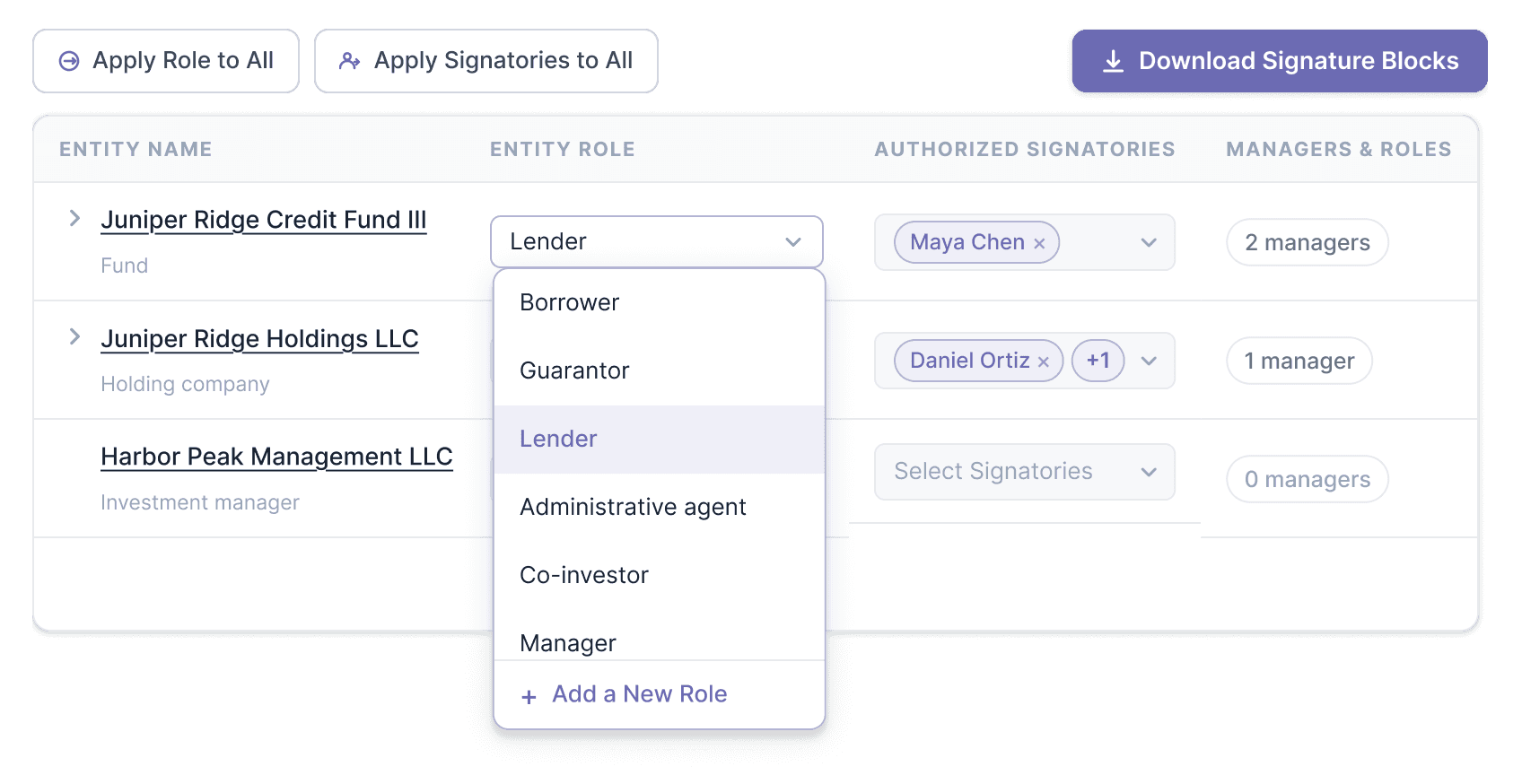
At the company level, users might need to prepare signature blocks outside an active deal. In this context, they could add or remove the relevant entities before completing the same configuration and download workflow.

Designing around a shared table kept the experience consistent while accounting for the main difference between the two contexts: whether PactFi already knew which entities belonged in the packet.

DESIGN DECISION 02
Assigning the same information one entity at a time became repetitive for larger packets. Users could initially apply one authorized signatory across all entities, and client feedback later led us to add the same bulk action for entity roles.
Because bulk updates could overwrite individual selections, we added confirmation messages explaining what would change and allowing users to cancel. We used the same pattern when removing entities from the company-level table. This made repetitive work faster while keeping high-impact changes clear and intentional.

DESIGN DECISION 03
Signature block order represents the legal relationship between an entity, its managers, and the person signing on its behalf. Because some entities had several management layers, users could expand each entity to review and reorder its manager rows without cluttering the main table. The order was saved to the backend and reflected accurately in the generated packet, ensuring the information reviewed in PactFi matched what counsel received.

PDFs provided a stable format for review and sharing, while Word files allowed counsel to edit and insert the blocks into transaction documents. Including signatories supported confirmed selections, while excluding them kept the packet flexible when the signer was undecided or would be added later.

VALIDATION AND LAUNCH
I used interactive prototypes to test whether users could configure signature blocks across multiple entities, understand the impact of bulk actions, and generate the correct document output. Feedback from internal reviews and client sessions shaped the experience before and after launch.
WHAT WE VALIDATED
Reviewing and editing information across multiple entities
Using bulk actions without losing confidence or control
Understanding how selections shaped the generated packet
Weekly sessions with design, product, and engineering surfaced edge cases, technical constraints, and opportunities to simplify the workflow.
Clients and prospective clients evaluated terminology, table interactions, bulk actions, and document outputs before development.
Signature Blocks launched in October 2025. Continued feedback revealed where teams and signatories needed more flexibility.
POST-LAUNCH INSIGHT
We expanded the capability with bulk role assignment, support for layered manager relationships, and the ability for authorized signatories to update their own signature blocks. These improvements reduced additional coordination while preserving control over sensitive legal information.
SIGNATURE BLOCKS OUTCOME
01
02
03
04
02
CUSTODIAN REPORTING
After Signature Blocks, I became the lead designer for Internal and External Custodian Reporting, another workflow that relied on information across a transaction.
Deal teams previously gathered deal details, entity information, and supporting documents manually before assembling standardized reports and distributing them to internal and external recipients by email. We brought the process into PactFi by reusing transaction data and documents already available in the platform.

How might we help deal teams create and distribute flexible reports using information already available across a transaction while accounting for incomplete dependencies? What appeared to be a report-generation feature was actually a connected workflow that needed to support:
Preview, save, and send reports Directly from PactFi


CUSTODIAN REPORTING OUTCOME
BROADER CONTRIBUTION
While Signature Blocks and Custodian Reporting were my largest areas of ownership, I also collaborated on Secondary Transfers and enhanced Parent Funds and other transaction workflows.
Working across the platform deepened my understanding of how information, permissions, and actions connected across PactFi.
It also strengthened my ability to enter unfamiliar product areas, ask the right questions, and contribute without becoming the sole domain expert.
OTHER CASE STUDIES


